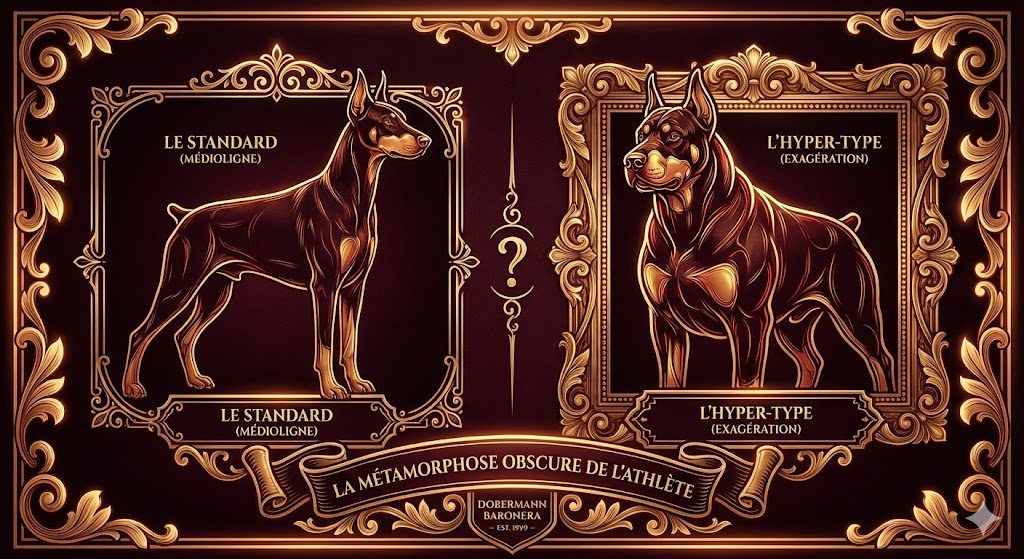
According to FCI Official Standard n°143, the Doberman is a medium-sized, square-built dog. It is an athlete built entirely of long muscles and agility. The appearance of subjects with massive bone structures is a major type rupture called Doberman Hyper-type. This phenomenon prioritizes raw mass over organic viability, transforming a fast working dog into a heavy, slow, and biologically condemned subject.
Comparison: Function vs Morphological Drift
- Official Standard: Long muscles, feline elegance, weight 88-99 lbs (adult male).
- Doberman Hyper-type: 88 lbs at only 6 or 8 months old, short muscles, excessive dewlap.
Growth Anomaly and Skeletal Rupture
Biology has immutable laws. In nature, a skeletal structure does not suddenly shift from a dry silhouette to a heavy mass without profound alteration. A 6 or 8-month-old puppy already weighing 88 lbs is a physiological aberration.
It is as if a human child changed bone stature to reach adult size in a matter of months: growth cartilage simply cannot keep up. This early weight overload in the Doberman Hyper-type leads to irreversible joint complications and chronic pain before the dog even reaches maturity. The Doberman skeleton was never designed to carry such a load before completing its mineralization.
Heart and Spine: The Price of Mass
Hyper-type selection weakens more than just limbs. An oversized neck, typical of the Doberman Hyper-type, strains the cervical vertebrae and promotes Wobbler Syndrome. But the most hidden danger remains the heart. Forcing a cardiac muscle—already under genetic pressure—to irrigate a molossoid body is a death sentence. In lineages marked by hyper-type, life expectancy collapses to 6 years. The engine fails because the body has become too heavy for the original Standard.
The Illusion of Power: Mass vs. Energy
Many novices confuse « power » with « volume. » A 120-lb dog is a handicapped animal, incapable of a lightning-fast reaction. To counter this Doberman Hyper-type drift, Baronera integrates bloodlines from Argentina and the USA. This new blood brings back the tonicity that the old continent has sometimes sacrificed. Our mixed lineages aim for robust cardiac health, far from the soft tissues and sagging toplines.
The Baronera Finding: The true nobility of the Doberman lies in its « thoroughbred » silhouette, not a molosser’s. A fast guard dog must remain a medium-built athlete to endure.
BACK TO MANIFESTO